Tag: review

The Wheel of Time Episode 2 – Shadow’s Waiting

The lady does shoot fireballs, so let’s try and stay on her good side.

— Mat Cauthon
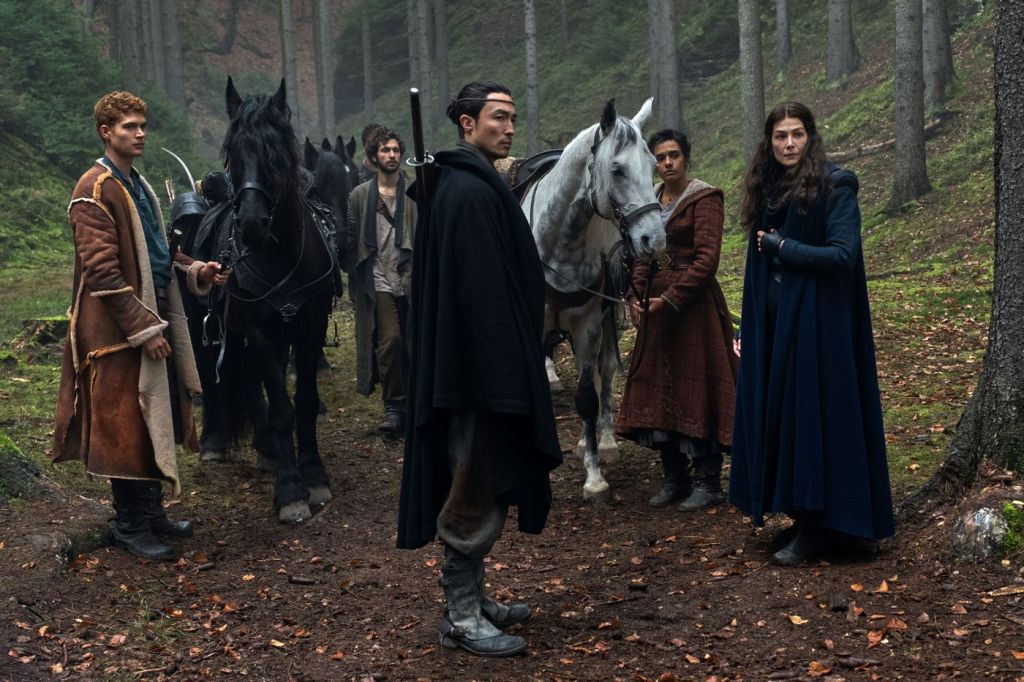
The second episode starts explosively. A terrified child, a vampiric army captain and a woman burning alive. ‘There’s a brutality to the dish’, the captain intones as he eats, banner-waving his own violent disposition. Half inquisitor, half witchhunter, Eamon Valda (Abdul Salis) of the Children of Light torments and burns his Aes Seddai captor – an execution made more lurid as we watch it reflected in his goblet and then blotted by his bloody fingers. A classic and effective piece of cinematography that could ask whether the captain is more akin to a vampire, without soul or reflection, who lusts for blood? He is, after all, deluded enough to think that brutality and mercy could ever co-exist.  

The episode also complicates this world’s politics in enticing ways. It makes very clear that not everyone follows the Aes Seddai. In fact, they are hunted as witches and enemies to the Light. It seems that calling yourself a follower of the Light does not make it so. Later, Moiraine crosses paths with the captain and the rest of the army of the Children of Light. She quickly removes her ring (to avoid having her hand removed entirely) and speaks around who she is. She does so convincingly and is allowed to continue her journey. Afterwards, Egwene accuses Moiraine of oath-breaking and lying to the captain. However, Moiraine is at pains to point out, ‘we will always tell the truth. It just may not be the truth you think you hear, so listen carefully’. This encapsulates both the importance of oaths and their flexibility. Oaths are clearly sacred in this world (consider what happened to the Fallen City when they betrayed an oath to aid their allies) but these oaths bend rather than break in the wind. This allows Moiraine to share just enough truth with the captain to keep his suspicions at bay but not so much that she endangers her life and the lives of those around her.

The captain’s hunt for the Aes Seddai goes to the heart of the female paradox. To obtain power as a woman is the only way to gain true independence yet power (or even ostensible power, as is the case with the 17th century witch trials) also makes you extremely vulnerable to persecution. In any time, and any world, it appears that being a woman, perhaps particularly one with authority, makes you a target.

The mysterious One Power the Aes Seddai draw on and the Light and the Dark the world is caught between seem to mimic, respectively, the single deity and dual deities of modern Wicca. Wicca is a diverse set of beliefs and Wiccans can view the divine as one impersonal force or embodied in dual deities: the Lord and the Lady. This gendered duality repeats itself in the the male and female channelers of the One Power. Perhaps implying that, in this world, the two and the one are inextricably bound together. This is a rather taoist understanding (an Ancient Chinese philosophy Wicca has been linked to) which encompasses both the Tao, an ultimate oneness which is the source of everything, and yin-yang, an idea of opposing yet interdependent forces.

Within this context, The Two Rivers (where our young protagonists hail from) could be seen to refer to the two forces of this world – the Light and the Dark – a creative dichotomoy that explains the Dragon’s rebirth there. Taoism teaches that within one energy, there is the seed of its opposite and perhaps this approximates Moiraine’s own ideology as she believes that in the reincarnation of the one who broke the world, the Dragon, is the beginning of the world’s saviour.

Vikings Season 5 Episode 16 – The Buddha

We are all trying to defend Ragnar’s dream but perhaps some of us choose to do it differently.

Björn

I can’t remember the last time Björn was so insightful. We find here all of Ragnar’s sons treading very different paths, each living his own incarnation of Ragnar’s dream.

Björn himself has been a caged bear for too long now. Pacing up and down the villa at Wessex, brooding in the corner, fucking royalty and (likely) bitching about his feather down pillows. He has no interest in winning Alfred’s trust or integrating into the English court. Ubbe has hardly been hob-knobbing with the bishops but at least the man is making an effort.

One thing Björn can be relied upon to do though is attract women. He finds himself with Gunnhild, a beautiful and fierce shieldmaiden in a scenario which echoes his first (and I would venture only) love, Thorunn. Both women openly acknowledge their lack of agency (Thorunn, a slave and Gunnhild, an imprisoned free woman), yet both genuinely desire Björn. For all his unearned fame as Ragnar’s son, he does have a powerful, charismatic presence and a natural inclination to lead. His departure from East Anglia comes as no surprise but his final farewell to Torvi is unexpectedly touching. Just as Ragnar paid final tribute to Auslaug, who was the mother of his sons but who he failed to truly love, Björn expresses his own thanks to his former lover who bore his children as well as the brunt of his temper. This apology hints at a self-awareness I have sorely missed from Björn while the similarities with Ragnar’s farewell prompts the question – is the beginning of the end for Björn?

So far, Hvitserk’s story has failed to inspire. He abandoned Ubbe, a brother he loved, to join Ivar, who can now only be described as a classic psychopath. When probed by Ubbe to explain this train wreck of a decision, he offered little more than ‘fate’. Despite Ivar’s win over Björn and Ubbe and acquisition of Kattegat, Hvitserk seems to wield little actual power and suffers under increasingly serious threats from his brother. Yet, here is a glimpse of something more in store for the most forgotten of Ragnar’s sons. Like his father, he has a curiosity for the world around him, transmuted into the Buddha totem he discovers at the market. Hvitserk is soon swimming in the mysteries and dichotomies of the doctrine and turning over the concept of oneness. It is this interest in the other which further claws at the rift between him and Ivar, who calls his attempt at mysticism ‘crazy’ and threatens him with the same brutal treatment that befell Margrethe.

Ragnar described himself as ‘a very curious man’ to Ecgbert, which often manifested itself as spiritual curiosity – he was continually eager to learn what new cities, what new Gods lay in wait over the horizon. It was this curiosity that fuelled his conversations with Athelstan and allowed him to learn, for instance, to attack on Sunday as the people would be unarmed and at church. This episode seems to draw a line of comparison between Hvitserk and his father – if he is sufficiently curious, perhaps he will also go on to achieve great things.

On the other hand, Ivar is proving himself more and more of a disappointment to Ragnar’s legacy. He no longer asks questions, preferring to bark orders. While his insistence at divine adulation is bizarre, it is also a fundamental block to increasing his reputation and status. If he is a God, he can do no wrong and he has nothing to learn. Any man who thinks he has nothing to learn is damned to a parochial existence at the least and death at worst, remember how Earl Haraldson’s refusal to raid West in Season 1 ended?

Finally, Ubbe. He has achieved what his father could not – farm land in England. After all, Ragnar was a farmer before a warrior and the greatest treasure he saw in this new land was not its rich (and undefended) churches but its fertile soil. But Ubbe has also assimilated far more than Ragnar ever did, exemplified by him and Torvi taking communion alongside the king. Of course, Alfred is also a different, far more trustworthy man than Ecgbert – as too, it seems, is Ubbe. Where Ragnar and Ecgbert both did unspeakable things to cling to power, Alfred and Ubbe have, so far, held onto their clean conscience. Therefore, it is not just outward assimilation of culture that makes this transaction possible, though of course the fact that Ubbe is a now Christian makes the whole enterprise a much easier sell for Alfred to his nobles. It is also about trust – pointing us to a reliable lesson that while getting what you want is certainly about greed, cunning and skill, the foundation must always be trust. That might be trust in a former enemy (Laegartha puts her trust in Ubbe, whose mother she murdered), trust in family (even Ecgbert trusted Aethelwulf) or trust in new friends (as Ubbe places his trust in Alfred). It is with this faith in another that even the most cynical enterprises can be built (circa Ecgbert’s tight grip on Wessex) and it is how Ubbe begins the building of an English settlement that will finally secure a prosperous future for the Vikings. In doing so, he becomes the embodiment of Ragnar’s best self, signalled by his long, braided hair. The same hair that Ragnar had at his peak and that Björn shaved off as his behaviour became ever more erratic. If Ragnar has one heir – Ubbe, at this moment, looks to be it.