Category: Vikings

Vikings Episode 19 – What Happens in the Cave

The world that Ragnar Lothbrok promised you. And his son, Ubbe, has delivered to you.

Alfred

The multiple threads of the season finally coalesce in What Happens in the Cave. While it might not draw the smoothest connections, the pace moves quickly and provides some satisfying conclusions across the board.

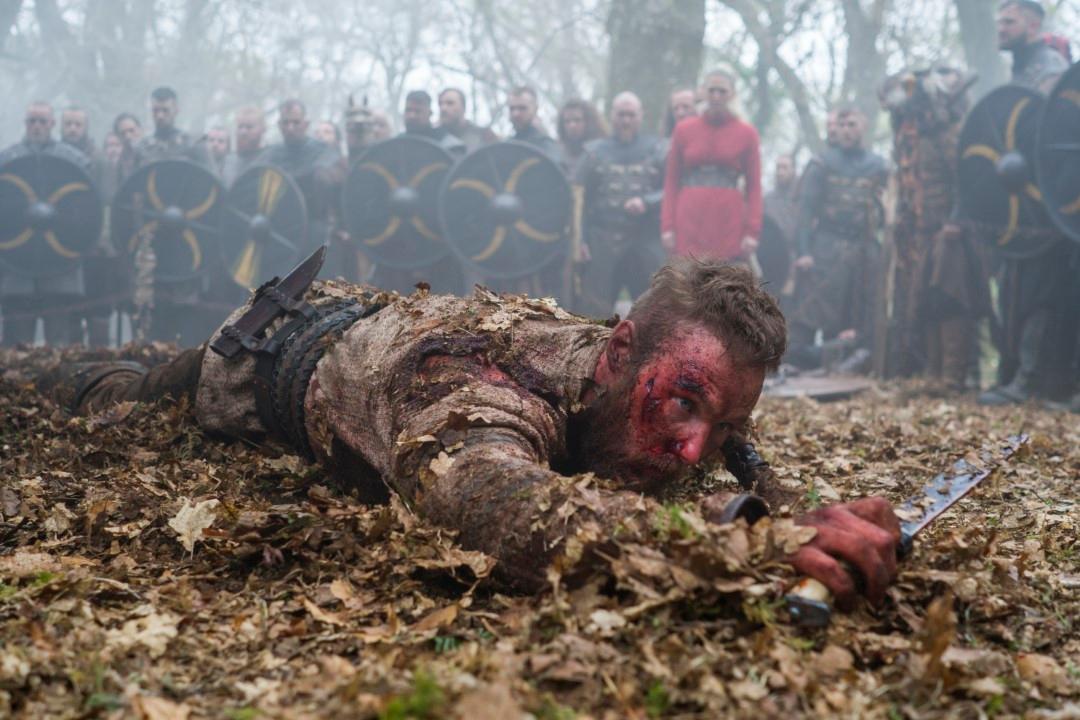
In an ironic twist of fate, Ubbe’s faith is restored just as Floki’s looks set to flounder. During their grisly, ungraceful fight, King Frodo floors Ubbe and Ubbe speaks straight to Odin. Afterwards, he describes the spirits of the Norse Gods working through him to Torvi and how he views his cross as a decorative addition and little more than that. Finally, we get the true meaning behind Ubbe’s forays into Christianity. This hasn’t been some kind of spiritual quest but, rather, an exploration of what the religion can do for him. Highly reminiscent of Ragnar’s faked conversion to smuggle his ‘dead’ body into Paris and instigate the city takeover that had previously eluded him. King Frodo and Ubbe’s fight is a messy, tense affair that creates genuine fear for Ubbe’s life before delivering his (oh so welcome) victory. Yet again, a son of Ragnar’s proves himself worthy of the hype.

In contrast, Floki’s journey to the centre of the earth in what he sees as the most sacred place to the Norse Gods ends in…a cross. Athelstan’s final fuck you. Floki half laughs, half cries as he realises he cannot escape the Christian God. Not even in Iceland, the supposed place of the Gods. His entire spiritual quest appears to be for naught. Well, unless you count a depressingly large death toll and cannibalistic side action (before his death, Eyvind resigns to just being ‘meat’ now). What will this mean for Floki’s faith? It is telling that Ubbe’s belief is renewed by the sweat and gristle of battle while Floki’s fragments in peaceful soul-searching. Norse paganism was forged from an idealisation of battle and that may well have been its downfall in a world where others were waking up to the fact that war is bad for business. Whereas Christ’s exaltation to ‘love thy neighbour’ lends itself to a more peaceful, economically prosperous environment, Norse mythology literally bars the door to Valhalla unless you die axe in hand.

‘The world that Ragnar Lothbrok promised you. And his son, Ubbe, has delivered to you.’ At last, we see the beginnings of a full Norse settlement that will pave the way for a total marrying of the Saxon and Viking worlds. Ubbe’s negotiation has bloodlessly sidestepped conflict and shown the Vikings to be, as King Angantyr says, much more than ‘savages’, emphasising too the multifarious nature of different cultures. The Vikings may be known to the Saxons as ruthless raiders, but they can also be, for the right piece of land, peaceful farmers.

We also see the story of Laegartha’s disappearance, her despair and injury forcing her from the battlefield to the house of an old, Saxon woman. This woman tells her to forget her old life as she cuts off her long, warrior locks, again emphasising the transformative power of hair for the series (see The Buddha). It’s clear that Laegartha’s shield maiden days are over and, if Ragnar’s demise is anything to go by, her days may be numbered. There has been extensive criticism of how Ragnar was ‘diminished’ leading up to his death but doesn’t age, eventually, diminish us all? Even Laegartha – beautiful, formidable, insightful, warrior she is – cannot escape its clutches and there’s some wider, inherent sense of justice to that.

Vikings Season 5 Episode 16 – The Buddha

We are all trying to defend Ragnar’s dream but perhaps some of us choose to do it differently.

Björn

I can’t remember the last time Björn was so insightful. We find here all of Ragnar’s sons treading very different paths, each living his own incarnation of Ragnar’s dream.

Björn himself has been a caged bear for too long now. Pacing up and down the villa at Wessex, brooding in the corner, fucking royalty and (likely) bitching about his feather down pillows. He has no interest in winning Alfred’s trust or integrating into the English court. Ubbe has hardly been hob-knobbing with the bishops but at least the man is making an effort.

One thing Björn can be relied upon to do though is attract women. He finds himself with Gunnhild, a beautiful and fierce shieldmaiden in a scenario which echoes his first (and I would venture only) love, Thorunn. Both women openly acknowledge their lack of agency (Thorunn, a slave and Gunnhild, an imprisoned free woman), yet both genuinely desire Björn. For all his unearned fame as Ragnar’s son, he does have a powerful, charismatic presence and a natural inclination to lead. His departure from East Anglia comes as no surprise but his final farewell to Torvi is unexpectedly touching. Just as Ragnar paid final tribute to Auslaug, who was the mother of his sons but who he failed to truly love, Björn expresses his own thanks to his former lover who bore his children as well as the brunt of his temper. This apology hints at a self-awareness I have sorely missed from Björn while the similarities with Ragnar’s farewell prompts the question – is the beginning of the end for Björn?

So far, Hvitserk’s story has failed to inspire. He abandoned Ubbe, a brother he loved, to join Ivar, who can now only be described as a classic psychopath. When probed by Ubbe to explain this train wreck of a decision, he offered little more than ‘fate’. Despite Ivar’s win over Björn and Ubbe and acquisition of Kattegat, Hvitserk seems to wield little actual power and suffers under increasingly serious threats from his brother. Yet, here is a glimpse of something more in store for the most forgotten of Ragnar’s sons. Like his father, he has a curiosity for the world around him, transmuted into the Buddha totem he discovers at the market. Hvitserk is soon swimming in the mysteries and dichotomies of the doctrine and turning over the concept of oneness. It is this interest in the other which further claws at the rift between him and Ivar, who calls his attempt at mysticism ‘crazy’ and threatens him with the same brutal treatment that befell Margrethe.

Ragnar described himself as ‘a very curious man’ to Ecgbert, which often manifested itself as spiritual curiosity – he was continually eager to learn what new cities, what new Gods lay in wait over the horizon. It was this curiosity that fuelled his conversations with Athelstan and allowed him to learn, for instance, to attack on Sunday as the people would be unarmed and at church. This episode seems to draw a line of comparison between Hvitserk and his father – if he is sufficiently curious, perhaps he will also go on to achieve great things.

On the other hand, Ivar is proving himself more and more of a disappointment to Ragnar’s legacy. He no longer asks questions, preferring to bark orders. While his insistence at divine adulation is bizarre, it is also a fundamental block to increasing his reputation and status. If he is a God, he can do no wrong and he has nothing to learn. Any man who thinks he has nothing to learn is damned to a parochial existence at the least and death at worst, remember how Earl Haraldson’s refusal to raid West in Season 1 ended?

Finally, Ubbe. He has achieved what his father could not – farm land in England. After all, Ragnar was a farmer before a warrior and the greatest treasure he saw in this new land was not its rich (and undefended) churches but its fertile soil. But Ubbe has also assimilated far more than Ragnar ever did, exemplified by him and Torvi taking communion alongside the king. Of course, Alfred is also a different, far more trustworthy man than Ecgbert – as too, it seems, is Ubbe. Where Ragnar and Ecgbert both did unspeakable things to cling to power, Alfred and Ubbe have, so far, held onto their clean conscience. Therefore, it is not just outward assimilation of culture that makes this transaction possible, though of course the fact that Ubbe is a now Christian makes the whole enterprise a much easier sell for Alfred to his nobles. It is also about trust – pointing us to a reliable lesson that while getting what you want is certainly about greed, cunning and skill, the foundation must always be trust. That might be trust in a former enemy (Laegartha puts her trust in Ubbe, whose mother she murdered), trust in family (even Ecgbert trusted Aethelwulf) or trust in new friends (as Ubbe places his trust in Alfred). It is with this faith in another that even the most cynical enterprises can be built (circa Ecgbert’s tight grip on Wessex) and it is how Ubbe begins the building of an English settlement that will finally secure a prosperous future for the Vikings. In doing so, he becomes the embodiment of Ragnar’s best self, signalled by his long, braided hair. The same hair that Ragnar had at his peak and that Björn shaved off as his behaviour became ever more erratic. If Ragnar has one heir – Ubbe, at this moment, looks to be it.

Vikings Season 5 Episode 15 – Hell

I knew then, with a beautiful certainty, that the day and the battle belonged to us! But without our Viking allies, I swear to you, there could be no victory.

— Alfred

vikings - hell

If there could be a microcosm for the entire series, this is it. The contrasts at play between Christianity and paganism, heaven and hell, good and evil underpin all of Vikings’ most substantial themes. Signs of the continual conflict characters must face are scattered through the hour like confetti.

First, we witness Ivar speak to the people of Kattegat in the great hall. Streaks of light fan out from the window behind him in an otherworldly aura as he opines on his own divinity. Yet, it is all smoke and mirrors. An artfully crafted (or cinematographed), superficial veneer. This scene beautifully hammers home how much of a façade Ivar’s Kattegat has become. The true link to their Gods was severed when Ivar murdered the seer, who did truly see the hearts and destinies of men. Now, all that remains is appearance. Ivar’s wife appears to be pregnant with his child, Ivar appears to be a God, the seer appears to have gone missing. We, the audience, know better – we know all these things to be mirage and trickery. Indeed, it is the expansion of this city of illusions that may provide the key to disentangling one of the primary contrasts of the series – between Christianity and paganism. While many corruptions can be laid at Christianity’s door, Alfred would never call himself divine. He is a conduit for God, yes, but not more than that. One thing which unites him and his people is there shared devotion to, and humility before, God. By positioning himself so far beyond his own people Ivar burns the traces of this common ground and, with it, the ties that hold a medieval community together and the silken restraints to his power. Perhaps that is what the seer meant when he wailed that, ‘all is darkness’.

Further fertile ground for symbolism is to be found in the stunning battle scene at the heart of this episode as Alfred’s army finally face King Harald. Vikings has always done battle scenes well. You feel the blood, sweat, mud and gore of hand-to-hand combat, steeped in the grisly realities of medieval warfare. Yet here the battle stands for something more than bone and gristle. It encapsulates the central Pagan/Christian conflict which haunts our characters. The fight between the Saxons and the Vikings is not just about who controls the land, or who wins the silver: it is, at its core, a battle of ideas. One God or many? Prayers or battle cries? The mysticism of the seer or the iron will of the church? Compassion and humility before Christ or the glory of battle?

Athelstan was torn between the Christian God and the Norse Gods, wavering from the faith of his early life enough to wear a Norse arm ring, before being found again clinging to his cross. His faith was fundamentally altered by his experiences in Norway and led him down a path he wouldn’t otherwise have tread – such as making love to a married woman. While it is Athelstan’s refusal to let go of Christianity that saves him from being sacrificed and brings him peace just before he meets his death, it is also a part of that death. Floki was driven by jealousy, of course, but part of his distaste for the ex-monk centred on his continued faith in the Christian God. Ragnar was also torn between these two worlds, intrigued by Athelstan’s faith and disenchanted with his own Gods, and their mutual spiritual doubt was likely one of the reasons he and Athelstan connected so deeply. Despite the fact they reach very different conclusions.

Within the current episode, the power of these two antithetical ways of life is crystallised in two objects: the cross and the arm ring. The exchange between Torvi and Ubbe on the eve of battle is telling as they flit back and forth from old Gods to new. Ubbe’s arm ring is discarded in favour of the cross but he, like his father, never conclusively chooses one faith over another. Rather, he adopts Christian ways because it works to his favour and he knows, if the Norse Gods do exist, they would be furious. Although Torvi puts the arm ring back in Ubbe’s hand, begging him to wear it, we, crucially, never see him put it back on. Bishop Heamund is also torn – between his human (and sinful) love for Laegartha, who he is not and never can be married to, and his divine love for God. Although he may be visited by a vision and decide to renounce her, it speaks of the depth of his struggle that, when death was nearest, he screams her name.

While Vikings provides no easy answers to this war of philosophies, we know who is ultimately triumphant. This makes the final scene where Magnus spits that Jesus Christ will be ‘utterly forgotten’ all the more poignant. In the end, there seemed to be a common devotion, and discipline, inspired by monotheism that outstripped the pagan religions and they paid the ultimate price, being written out of living history.