Love’s usually a bad idea. Still, we allow it to happen, or this life would be intolerable.
— Stephin
An uneven episode with moments of real tension – and moments that can feel contrived and overly indulgent. We begin in the city of Tar Valon a month after where we left off. Once again, the sets are stunning. The cityscape is an intricate display of white stone, rainbow decor and wildlife from around the world. The inhabitants are bedecked in glistening tunics, and wealth and prosperity seem to drip from every corner.
We spend a significant amount of time on the posthumous bond between an Aes Sedai and her warder. Which would be fine if it served the wider story but Stephin’s (Peter Franzén) crippling depression without Kerene (Clare Perkins) leaves the audience mostly cold. Afterall, we barely know them. The gravitas of these events isn’t fully felt until we see Lan’s self-composure shatter. Perhaps out of guilt (from what was essentially a failed suicide watch) or grief Lan’s deconstruction is gutwrenching. And all the more so for the unspoken mutual pain between him and Moiraine. There must be a reason we are seeing all this – will the bond between Moiraine and Lan be threatened? Will they lose each other? The nature of their relatonship does not appear romantic or sexual (although that is definitely an option going by the friskiness of the sexy Aes Sedai-warder triad). Stephin describes love as what makes life tolerable, a definition Lan quickly dismisses. This suggests Lan values other things more, like duty and purpose. Yet their exchange could be more prescient, foreshadowing the challenges to come. Perhaps it will be love that comes between Lan and Moiraine.
There are things worse than death and apparently one of them is madness, as Mat asks Rand to kill him before he becomes like the false Dragon. While madness is a useful plot device and Mat’s fear feels very real, it is a rather hackneyed portrayal of mental health where hearing voices is the biggest bad imaginable. The reality is up to one in ten people will hear voices in their liftetime and of those who do, some would not be considered clinically ‘mad’ as the voices do not cause them distress. There is also the possibility of recovery – either through silencing the voices or finding a way to co-exist with them. But, granted, it is medieval fantasy and the madness is interwoven with the magical contamination of the One Power.
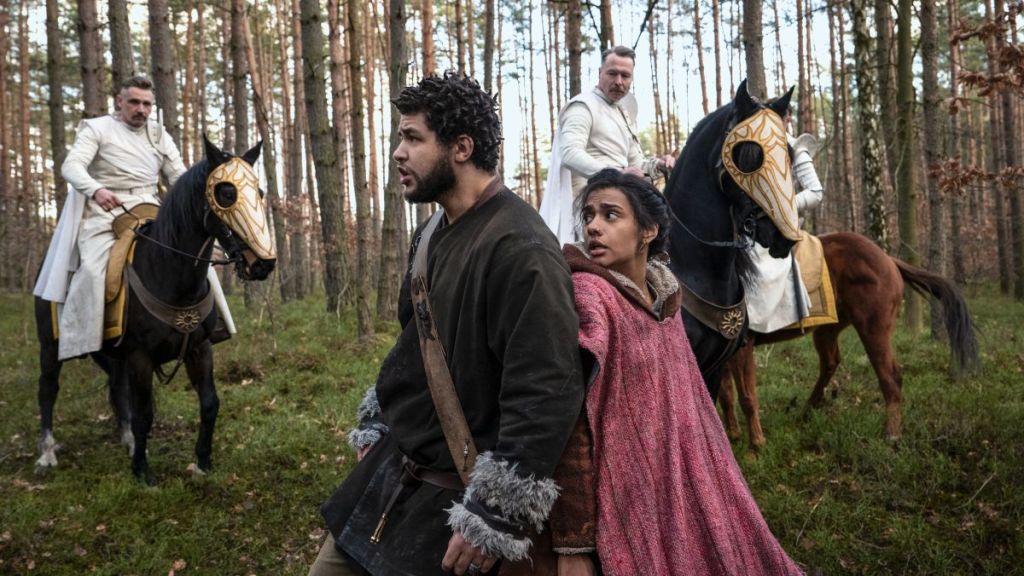
It’s become more clear that flat characterisation is the result of bad writing, rather than bad acting. When Nynaeve (Zoë Robins) tells Rand (Josha Stradowski) about how Egwene’s tenacity ensured her survival from a gruesome childhood illness, it’s emotionally pitched to have an impact but Rand’s cheesy one-liner ‘sounds about right’ tunes the audience out. This episode tries to breathe life into Egwene’s character but honestly it feels like hot air. We get a tired fiesty-girl-from-the-village stereotype with very little to substantiate it. Her tough talk against Valda, the Children of Light captain, comes out of nowhere and it is Perrin that eventually saves their sorry asses.
But while the Wheel of Time may lack character development, it does give us nail-biting tension. Egwene and Perrin’s predicament looks dire – we know Valda is brutal and out for blood and Egwene’s powers are in their infancy. She tries to appeal to his own principles, ‘a man of the Light cannot kill a girl who’s done nothing wrong!’ but the righteous have a unique ability to the twist truth to suit their own agenda. Like any religious fundamentalist, Valda is utterly convinced that his understanding of the divine is the understanding of the divine. He believes that humans were never meant to access the One Power and that any ‘witches’ who touch it ‘walk like gods amongst men’. The irony being that in his enforcement of these beliefs, he wields more power than the people he condemns (even the Aes Sedai). Of course, it is also the gall of these women, these ‘witches’ to believe they are somehow above men. It does not seem like too far a stretch to think that whoever Valda encountered, able to touch the source or not, would have been subject to his torture and denunciation. Those who are dogmatically ‘guided’ by the divine, like Valda and Dana, appear to be the most dangerous – whichever side they are supposed to serve. So much so that the differences between spiritual opposites – Light and Dark – seem not so great at all.
 Show. Interpreted.