Category: The Wheel of Time

The Wheel of Time Episode 3 – A Place of Safety

The Wheel hasn’t given me many choices, and the ones that I’ve made have left me here.

— Dana
A much more fractured episode than its predecessors. We witness our travelling group divided into three geographies and stories, and the quality suffers as a result. The almost total absence of Moiraine underscores how much of the show’s allure she is responsible for.

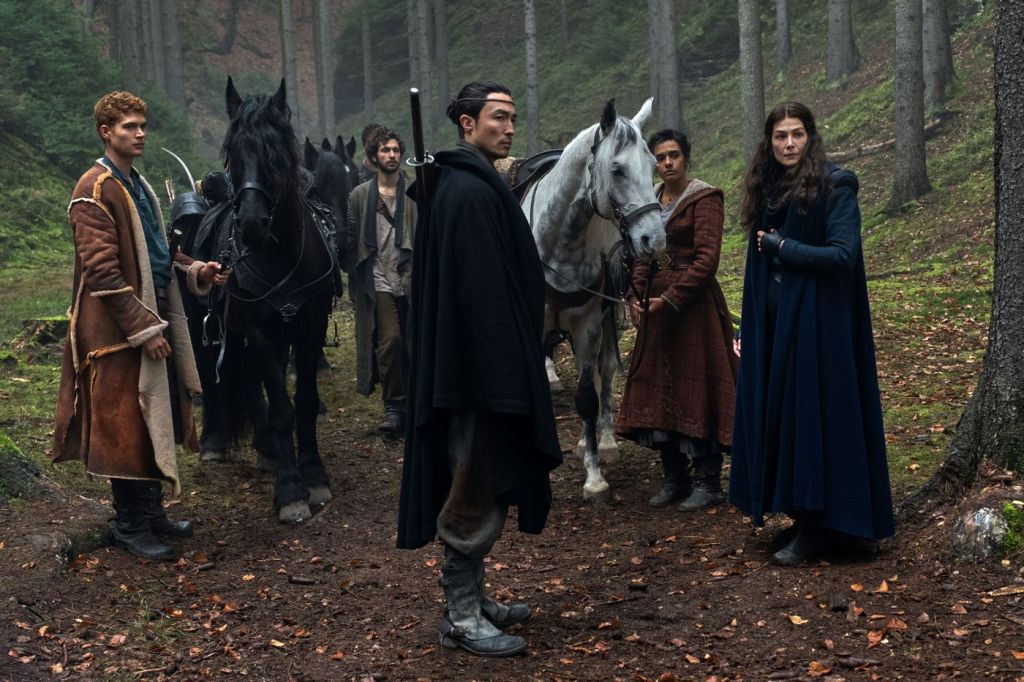
What does work are the stunning locations which have become an additional cast member: each setting shaping the distinct character of the journey. The verdant forest that hosts Moiraine, Lan and Nynaeve evokes nature’s life-giving, balancing force – their journey is one of healing. The abundant green moss and lush trees are a feast for the eyes and cruel contrast to the flesh rotting at Moiraine’s shoulder. Nynaeve’s skill and power as a Wisdom only goes so far (despite sporting that emerald coat). She can renew Moiraine’s energy temporarily but it’s clear the Sisters’ healing powers are needed for Moiraine to survive. The relationship between an Aes Seddai and her warder is hinted at by some quite clumsy exposition from Nynaeve – apparently a Warder is so entwined with his Aes Seddai, he feels what she feels. How literally this should be interpreted remains unclear as Moiraine’s ‘unbearably painful’ treatment barely makes Lan grimace (or is this just medieval macho posturing?)

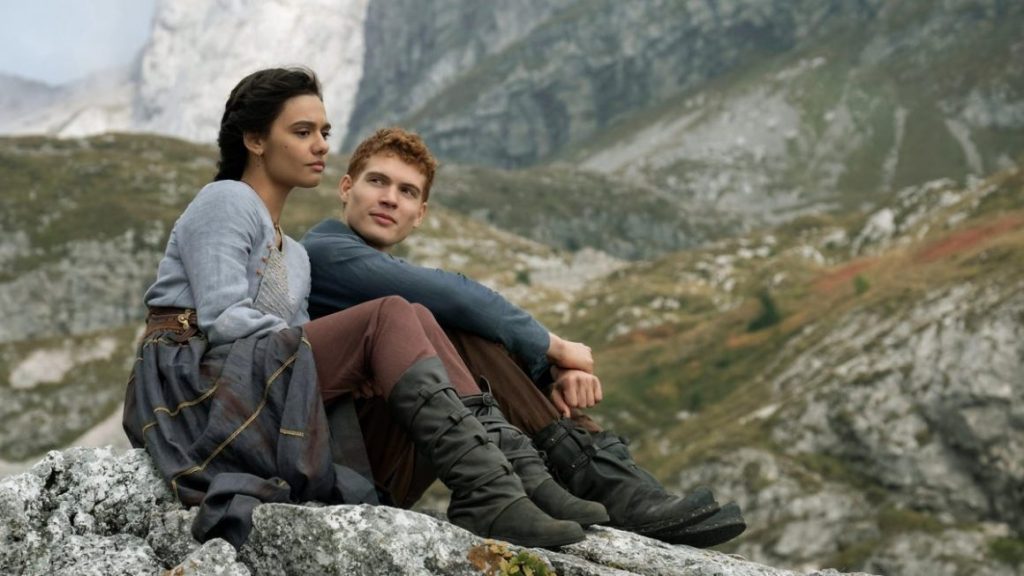
A cold mountainous wasteland is fitting backdrop to the most sparse and empty storyline: Perrin and Egwene’s trek to nowhere. The wolves hound them night and day, apparently leading them to the edge of a misty forest. There, they meet the friendliest group of people a stranger could hope to encounter. The Travelling People feel like a lazy comparison to the Roma and there is an overdone bucking of stereotypes i.e. ‘The people who [are known to] steal your gold and your children’ but are actually lovely and want nothing more than to give you free lentils.

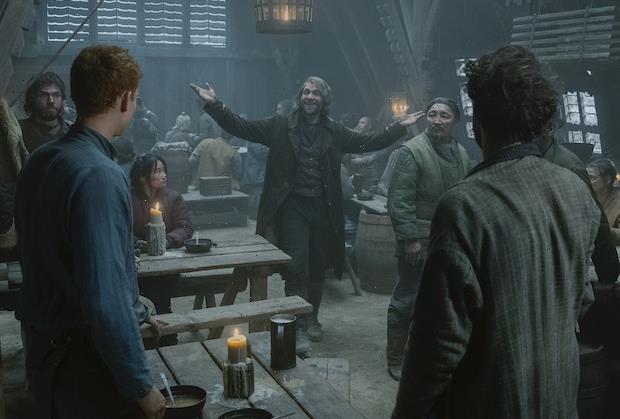
The most interesting story thread is Rand and Mat’s diversion into a gritty, dark mining town. They stumble into a tavern with a welcoming, enchanting host – Dana. We watch as she teases and compliments each in turn, Rand’s dedication and Mat’s humour, all the while a slightly sinister sense builds. During this time, Mat is also robbed by a Gleeman, a travelling bard-type, who optimistically refers to his theft as a ‘life lesson’. Yet, it’s when their lives are at stake, Mat and Rand learn the real lesson of this town – how deceptive appearances can be. We’re constantly reminded that first impressions count but this world has a very different take. Dana is outwardly friendly and generous yet she tries to trap Rand and summons an Eyeless to take him away (how does one summon an Eyeless exactly? It’s not like they get good phone reception in the netherworld). The Gleeman robs Mat on sight but ends up saving his and Rand’s life when he puts an arrow through Dana’s throat. Her death turns into one of the most memorable cut scenes so far, her blood billowing out into a muddy pool and morphing into the trees at the culmination of Moraine, Lan and Nynaeve’s journey.

Dana also tells us there are five possible Dragons. A revelation made real as we see our final potential, caged and likely headed for an untimely death. We are left wondering if Moiraine has enough strength left to save him, or if he even should be saved. Why do male channellers go mad? Has the the duality of power, Light and Dark, male and female, been disrupted somehow? Perhaps the community of the Aes Seddai help quell the dangers of women wielding the One Power whereas the solitary male channellers go mad from holding the burden of power alone. After all, there is strength in community and in sisterhood.
The Wheel of Time Episode 2 – Shadow’s Waiting

The lady does shoot fireballs, so let’s try and stay on her good side.

— Mat Cauthon

The second episode starts explosively. A terrified child, a vampiric army captain and a woman burning alive. ‘There’s a brutality to the dish’, the captain intones as he eats, banner-waving his own violent disposition. Half inquisitor, half witchhunter, Eamon Valda (Abdul Salis) of the Children of Light torments and burns his Aes Seddai captor – an execution made more lurid as we watch it reflected in his goblet and then blotted by his bloody fingers. A classic and effective piece of cinematography that could ask whether the captain is more akin to a vampire, without soul or reflection, who lusts for blood? He is, after all, deluded enough to think that brutality and mercy could ever co-exist.  

The episode also complicates this world’s politics in enticing ways. It makes very clear that not everyone follows the Aes Seddai. In fact, they are hunted as witches and enemies to the Light. It seems that calling yourself a follower of the Light does not make it so. Later, Moiraine crosses paths with the captain and the rest of the army of the Children of Light. She quickly removes her ring (to avoid having her hand removed entirely) and speaks around who she is. She does so convincingly and is allowed to continue her journey. Afterwards, Egwene accuses Moiraine of oath-breaking and lying to the captain. However, Moiraine is at pains to point out, ‘we will always tell the truth. It just may not be the truth you think you hear, so listen carefully’. This encapsulates both the importance of oaths and their flexibility. Oaths are clearly sacred in this world (consider what happened to the Fallen City when they betrayed an oath to aid their allies) but these oaths bend rather than break in the wind. This allows Moiraine to share just enough truth with the captain to keep his suspicions at bay but not so much that she endangers her life and the lives of those around her.

The captain’s hunt for the Aes Seddai goes to the heart of the female paradox. To obtain power as a woman is the only way to gain true independence yet power (or even ostensible power, as is the case with the 17th century witch trials) also makes you extremely vulnerable to persecution. In any time, and any world, it appears that being a woman, perhaps particularly one with authority, makes you a target.

The mysterious One Power the Aes Seddai draw on and the Light and the Dark the world is caught between seem to mimic, respectively, the single deity and dual deities of modern Wicca. Wicca is a diverse set of beliefs and Wiccans can view the divine as one impersonal force or embodied in dual deities: the Lord and the Lady. This gendered duality repeats itself in the the male and female channelers of the One Power. Perhaps implying that, in this world, the two and the one are inextricably bound together. This is a rather taoist understanding (an Ancient Chinese philosophy Wicca has been linked to) which encompasses both the Tao, an ultimate oneness which is the source of everything, and yin-yang, an idea of opposing yet interdependent forces.

Within this context, The Two Rivers (where our young protagonists hail from) could be seen to refer to the two forces of this world – the Light and the Dark – a creative dichotomoy that explains the Dragon’s rebirth there. Taoism teaches that within one energy, there is the seed of its opposite and perhaps this approximates Moiraine’s own ideology as she believes that in the reincarnation of the one who broke the world, the Dragon, is the beginning of the world’s saviour.

The Wheel of Time Episode 1 – Leavetaking

Your life isn’t going to be what you thought. You’ve lived too long in these mountains, pretending what happens in the rest of the world won’t affect you.


— Moiraine

The Wheel of Time lays the groundwork for a well-worn fantasy trope – the ultimate battle between good and evil (here, ‘light’ and ‘dark’) where only the chosen one can bring salvation. The subversion here is a matriarchal council of wise women known as the Aes Sedai who wield great power, and the fact there are four competing candidates for our hero(ine), known as the ‘Dragon’ reborn.

The exposition comes thick and fast over this first installment. The Eyeless, the Aes Sedai, the Wisdom, the Light, trollocs – there’s barely a moment to take in the breathtaking landscape (cue en-masse googling of ‘where is The Wheel of Time shot?’). Despite this terminology vomit, the show weaves a foreboding and mystical atmosphere over the course of its 50 minute run-time. Rosamund Pike excels as the austere and intimidating Moiraine who humanises her just enough as she searches for the Dragon with her warrior companion, Lan. Her search leads her to the Two Rivers, a small village in the mountains.

There are several comments about the remoteness of the town in both geographical and political terms – what happens elsewhere never seems to affect the villagers. Perhaps this is a barb about communities, or individuals, that attempt to cut themselves off from the wider world’s concerns. In the end though, the world comes to you. Moiraine is here for the four young villagers who have come of age. Personal transformation beckons as we turn away from youth, teetering on the precipice of adulthood, and this is mimicked by the stark shifts the protagonists – Egwene, Rand, Mat and Perrin – face.

Egwene and Rand are young, beautiful and in love, surely enough to ensure a doomed future together. Egwene passes through her ceremony into womanhood, symbolised by her braided hair (a nice nod to the spiritual significance hair can hold, notably in Sikhism and Islam), and then has sex with her childhood love Rand, only to tell him they will never marry. She is set on the life of a Wisdom. A ‘lonely life’, as Rand reminds her, without husband or children, existing as a kind of feminine incarnation of the catholic priesthood. Mat and his family are dirt poor (dirt being the operative word, his younger sisters have all but taken a mud bath) and he has to resort to stealing from acquaintances to survive. Perrin is given less backstory – he seems strangely interested in Egwene but also has a wife who he (proclaims) he loves, and then unintentionally kills soon after. No doubt such a dark and unfortunate act will weigh heavily on his conscience.

The episode crescendos when the town is attacked by a small army of trollocs – a three-way gene splice between an orc, a devil and a goat. There is carnage, terror and some very questionable CGI effects. Visualising magic is always a challenge, but this attempt feels more half-baked than most. Moiraine throws pulsating lightning rods at the enemy while villagers alternate between fleeing and fighting hysterically. Rand’s father is surprisingly skilled with a portent-bearing sword – hinting at secrets in their family history. After barely scraping through alive, Moiraine and the four potential Dragons must leave abruptly and journey to the White Tower to find safety. An uneven yet captivating beginning to their journey into the Darkness and the Light.