Your life isn’t going to be what you thought. You’ve lived too long in these mountains, pretending what happens in the rest of the world won’t affect you.
— Moiraine
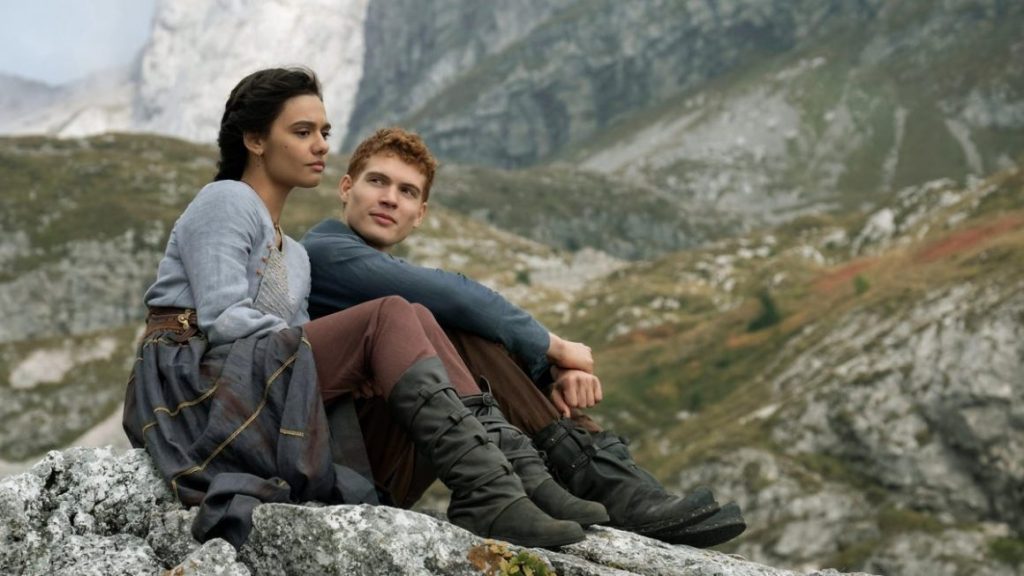
The Wheel of Time lays the groundwork for a well-worn fantasy trope – the ultimate battle between good and evil (here, ‘light’ and ‘dark’) where only the chosen one can bring salvation. The subversion here is a matriarchal council of wise women known as the Aes Sedai who wield great power, and the fact there are four competing candidates for our hero(ine), known as the ‘Dragon’ reborn.
The exposition comes thick and fast over this first installment. The Eyeless, the Aes Sedai, the Wisdom, the Light, trollocs – there’s barely a moment to take in the breathtaking landscape (cue en-masse googling of ‘where is The Wheel of Time shot?’). Despite this terminology vomit, the show weaves a foreboding and mystical atmosphere over the course of its 50 minute run-time. Rosamund Pike excels as the austere and intimidating Moiraine who humanises her just enough as she searches for the Dragon with her warrior companion, Lan. Her search leads her to the Two Rivers, a small village in the mountains.
There are several comments about the remoteness of the town in both geographical and political terms – what happens elsewhere never seems to affect the villagers. Perhaps this is a barb about communities, or individuals, that attempt to cut themselves off from the wider world’s concerns. In the end though, the world comes to you. Moiraine is here for the four young villagers who have come of age. Personal transformation beckons as we turn away from youth, teetering on the precipice of adulthood, and this is mimicked by the stark shifts the protagonists – Egwene, Rand, Mat and Perrin – face.
Egwene and Rand are young, beautiful and in love, surely enough to ensure a doomed future together. Egwene passes through her ceremony into womanhood, symbolised by her braided hair (a nice nod to the spiritual significance hair can hold, notably in Sikhism and Islam), and then has sex with her childhood love Rand, only to tell him they will never marry. She is set on the life of a Wisdom. A ‘lonely life’, as Rand reminds her, without husband or children, existing as a kind of feminine incarnation of the catholic priesthood. Mat and his family are dirt poor (dirt being the operative word, his younger sisters have all but taken a mud bath) and he has to resort to stealing from acquaintances to survive. Perrin is given less backstory – he seems strangely interested in Egwene but also has a wife who he (proclaims) he loves, and then unintentionally kills soon after. No doubt such a dark and unfortunate act will weigh heavily on his conscience.
The episode crescendos when the town is attacked by a small army of trollocs – a three-way gene splice between an orc, a devil and a goat. There is carnage, terror and some very questionable CGI effects. Visualising magic is always a challenge, but this attempt feels more half-baked than most. Moiraine throws pulsating lightning rods at the enemy while villagers alternate between fleeing and fighting hysterically. Rand’s father is surprisingly skilled with a portent-bearing sword – hinting at secrets in their family history. After barely scraping through alive, Moiraine and the four potential Dragons must leave abruptly and journey to the White Tower to find safety. An uneven yet captivating beginning to their journey into the Darkness and the Light.
 Show. Interpreted.