The world that Ragnar Lothbrok promised you. And his son, Ubbe, has delivered to you.
—Alfred
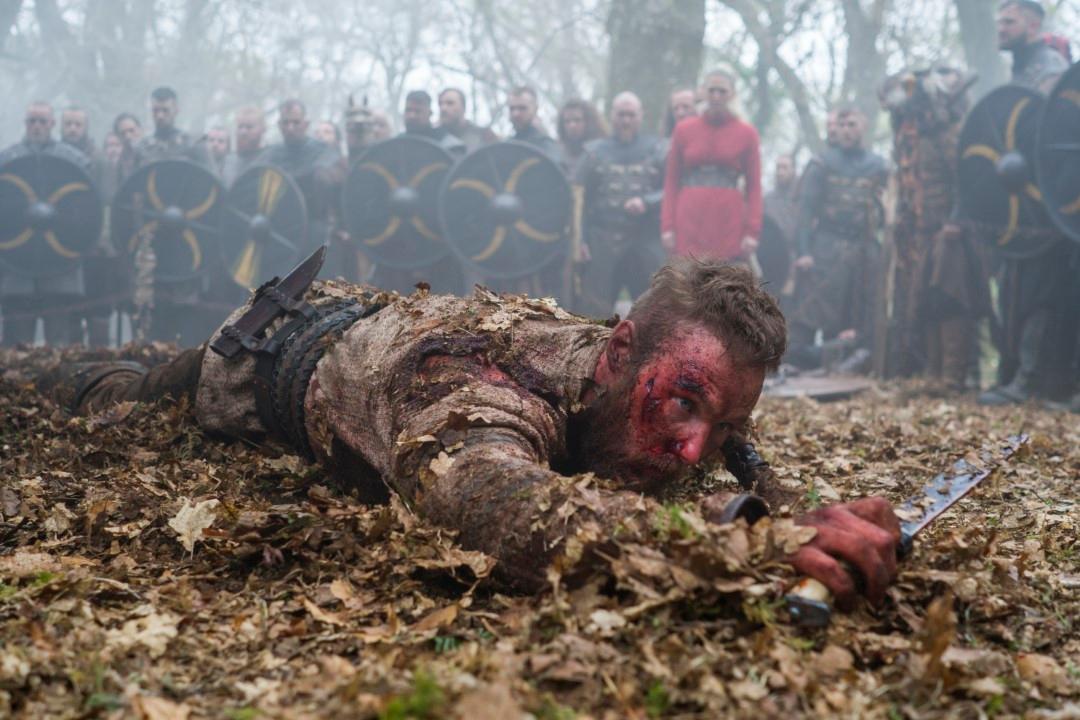
The multiple threads of the season finally coalesce in What Happens in the Cave. While it might not draw the smoothest connections, the pace moves quickly and provides some satisfying conclusions across the board.
In an ironic twist of fate, Ubbe’s faith is restored just as Floki’s looks set to flounder. During their grisly, ungraceful fight, King Frodo floors Ubbe and Ubbe speaks straight to Odin. Afterwards, he describes the spirits of the Norse Gods working through him to Torvi and how he views his cross as a decorative addition and little more than that. Finally, we get the true meaning behind Ubbe’s forays into Christianity. This hasn’t been some kind of spiritual quest but, rather, an exploration of what the religion can do for him. Highly reminiscent of Ragnar’s faked conversion to smuggle his ‘dead’ body into Paris and instigate the city takeover that had previously eluded him. King Frodo and Ubbe’s fight is a messy, tense affair that creates genuine fear for Ubbe’s life before delivering his (oh so welcome) victory. Yet again, a son of Ragnar’s proves himself worthy of the hype.
In contrast, Floki’s journey to the centre of the earth in what he sees as the most sacred place to the Norse Gods ends in…a cross. Athelstan’s final fuck you. Floki half laughs, half cries as he realises he cannot escape the Christian God. Not even in Iceland, the supposed place of the Gods. His entire spiritual quest appears to be for naught. Well, unless you count a depressingly large death toll and cannibalistic side action (before his death, Eyvind resigns to just being ‘meat’ now). What will this mean for Floki’s faith? It is telling that Ubbe’s belief is renewed by the sweat and gristle of battle while Floki’s fragments in peaceful soul-searching. Norse paganism was forged from an idealisation of battle and that may well have been its downfall in a world where others were waking up to the fact that war is bad for business. Whereas Christ’s exaltation to ‘love thy neighbour’ lends itself to a more peaceful, economically prosperous environment, Norse mythology literally bars the door to Valhalla unless you die axe in hand.
‘The world that Ragnar Lothbrok promised you. And his son, Ubbe, has delivered to you.’ At last, we see the beginnings of a full Norse settlement that will pave the way for a total marrying of the Saxon and Viking worlds. Ubbe’s negotiation has bloodlessly sidestepped conflict and shown the Vikings to be, as King Angantyr says, much more than ‘savages’, emphasising too the multifarious nature of different cultures. The Vikings may be known to the Saxons as ruthless raiders, but they can also be, for the right piece of land, peaceful farmers.
We also see the story of Laegartha’s disappearance, her despair and injury forcing her from the battlefield to the house of an old, Saxon woman. This woman tells her to forget her old life as she cuts off her long, warrior locks, again emphasising the transformative power of hair for the series (see The Buddha). It’s clear that Laegartha’s shield maiden days are over and, if Ragnar’s demise is anything to go by, her days may be numbered. There has been extensive criticism of how Ragnar was ‘diminished’ leading up to his death but doesn’t age, eventually, diminish us all? Even Laegartha – beautiful, formidable, insightful, warrior she is – cannot escape its clutches and there’s some wider, inherent sense of justice to that.
 Show. Interpreted.