I knew then, with a beautiful certainty, that the day and the battle belonged to us! But without our Viking allies, I swear to you, there could be no victory.
— Alfred
If there could be a microcosm for the entire series, this is it. The contrasts at play between Christianity and paganism, heaven and hell, good and evil underpin all of Vikings’ most substantial themes. Signs of the continual conflict characters must face are scattered through the hour like confetti.
First, we witness Ivar speak to the people of Kattegat in the great hall. Streaks of light fan out from the window behind him in an otherworldly aura as he opines on his own divinity. Yet, it is all smoke and mirrors. An artfully crafted (or cinematographed), superficial veneer. This scene beautifully hammers home how much of a façade Ivar’s Kattegat has become. The true link to their Gods was severed when Ivar murdered the seer, who did truly see the hearts and destinies of men. Now, all that remains is appearance. Ivar’s wife appears to be pregnant with his child, Ivar appears to be a God, the seer appears to have gone missing. We, the audience, know better – we know all these things to be mirage and trickery. Indeed, it is the expansion of this city of illusions that may provide the key to disentangling one of the primary contrasts of the series – between Christianity and paganism. While many corruptions can be laid at Christianity’s door, Alfred would never call himself divine. He is a conduit for God, yes, but not more than that. One thing which unites him and his people is there shared devotion to, and humility before, God. By positioning himself so far beyond his own people Ivar burns the traces of this common ground and, with it, the ties that hold a medieval community together and the silken restraints to his power. Perhaps that is what the seer meant when he wailed that, ‘all is darkness’.
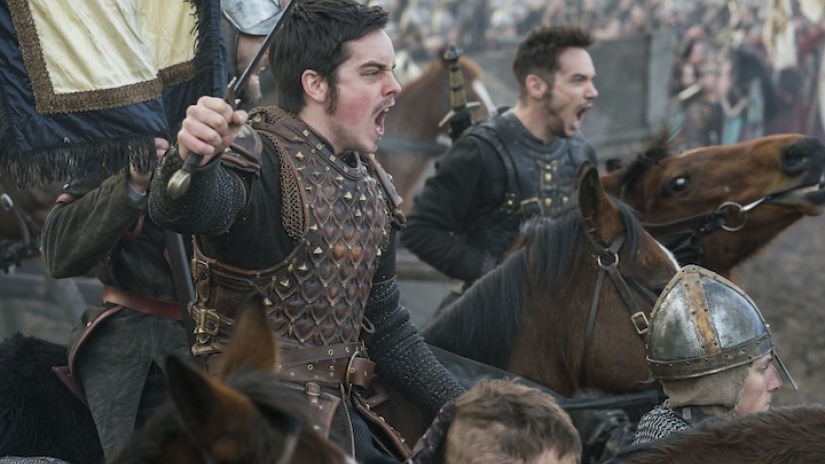
Further fertile ground for symbolism is to be found in the stunning battle scene at the heart of this episode as Alfred’s army finally face King Harald. Vikings has always done battle scenes well. You feel the blood, sweat, mud and gore of hand-to-hand combat, steeped in the grisly realities of medieval warfare. Yet here the battle stands for something more than bone and gristle. It encapsulates the central Pagan/Christian conflict which haunts our characters. The fight between the Saxons and the Vikings is not just about who controls the land, or who wins the silver: it is, at its core, a battle of ideas. One God or many? Prayers or battle cries? The mysticism of the seer or the iron will of the church? Compassion and humility before Christ or the glory of battle?
Athelstan was torn between the Christian God and the Norse Gods, wavering from the faith of his early life enough to wear a Norse arm ring, before being found again clinging to his cross. His faith was fundamentally altered by his experiences in Norway and led him down a path he wouldn’t otherwise have tread – such as making love to a married woman. While it is Athelstan’s refusal to let go of Christianity that saves him from being sacrificed and brings him peace just before he meets his death, it is also a part of that death. Floki was driven by jealousy, of course, but part of his distaste for the ex-monk centred on his continued faith in the Christian God. Ragnar was also torn between these two worlds, intrigued by Athelstan’s faith and disenchanted with his own Gods, and their mutual spiritual doubt was likely one of the reasons he and Athelstan connected so deeply. Despite the fact they reach very different conclusions.
Within the current episode, the power of these two antithetical ways of life is crystallised in two objects: the cross and the arm ring. The exchange between Torvi and Ubbe on the eve of battle is telling as they flit back and forth from old Gods to new. Ubbe’s arm ring is discarded in favour of the cross but he, like his father, never conclusively chooses one faith over another. Rather, he adopts Christian ways because it works to his favour and he knows, if the Norse Gods do exist, they would be furious. Although Torvi puts the arm ring back in Ubbe’s hand, begging him to wear it, we, crucially, never see him put it back on. Bishop Heamund is also torn – between his human (and sinful) love for Laegartha, who he is not and never can be married to, and his divine love for God. Although he may be visited by a vision and decide to renounce her, it speaks of the depth of his struggle that, when death was nearest, he screams her name.
While Vikings provides no easy answers to this war of philosophies, we know who is ultimately triumphant. This makes the final scene where Magnus spits that Jesus Christ will be ‘utterly forgotten’ all the more poignant. In the end, there seemed to be a common devotion, and discipline, inspired by monotheism that outstripped the pagan religions and they paid the ultimate price, being written out of living history.
 Show. Interpreted.